

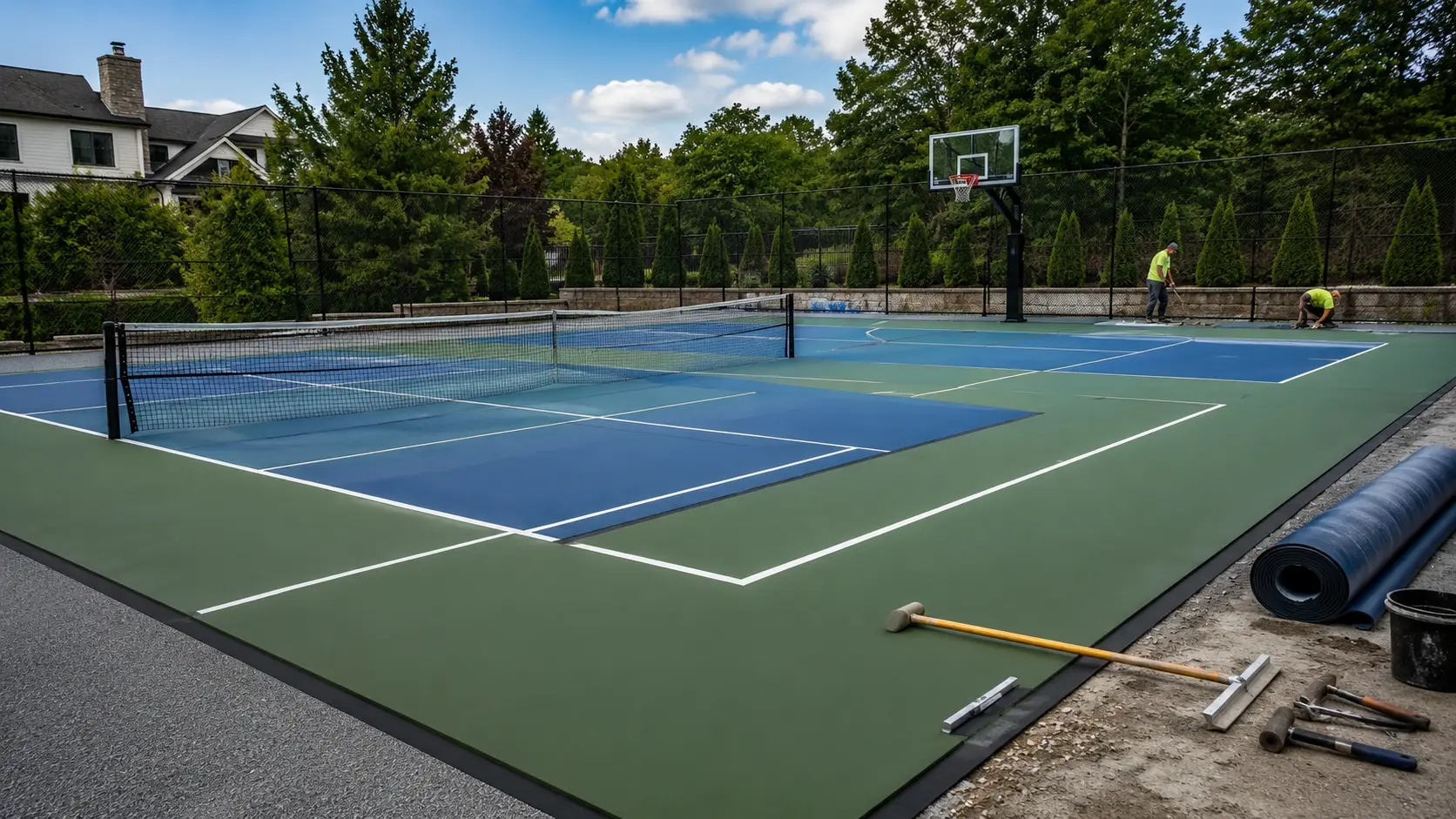
A backyard pickleball court. A community tennis facility. A basketball court for a school or church. Whatever the project, a sport court is one of the highest-value additions you can make to a residential or commercial property and one of the least forgiving to get wrong. A court that isn’t graded, drained, paved, and coated correctly will crack, pond water, and fade within a few seasons, turning a premium investment into a recurring repair bill.
This guide walks through the entire sport court installation process from raw ground to painted lines, so you know exactly what a professional build involves, where the real costs and risks hide, and what questions to ask before breaking ground.
Why Sport Court Demand Is Surging
The pickleball boom is the headline story. Pickleball has been the fastest-growing sport in America for several years running, and demand for dedicated courts has far outpaced supply. Homeowners are converting backyard space, HOAs are adding courts as amenities, and municipalities and schools are retrofitting underused tennis courts with pickleball lines.
But the demand isn’t limited to pickleball. Tennis remains a staple for clubs, schools, and high-end residential properties, and outdoor basketball courts are perennial favorites for families, churches, parks, and recreation departments. All three sports share the same fundamental construction sequence which is why an experienced site work and paving contractor can build any of them.
Step 1: Site Selection and Evaluation
Every successful court starts before a shovel touches the ground. A proper site evaluation looks at:
- Space Requirements: You need more than the playing surface itself; you need run-off room around the lines. A regulation tennis court needs a pad of roughly 120′ x 60′. A pickleball court fits comfortably on a 34′ x 64′ pad. A full basketball court requires about 94′ x 50′, though half-courts of 47′ x 50′ (or smaller residential versions) are common.
- Slope and Grading: Courts must be nearly flat but not perfectly flat a slight, uniform slope of about 1% (typically 0.83%–1%) allows water to sheet off the surface. Building on a hillside, which is common in West Virginia, often means significant excavation, cut-and-fill work, and retaining considerations.
- Soil Conditions: Expansive clay, poor compaction, or high water tables cause the majority of premature court failures. A contractor with earthworks experience can identify problem soils and design the sub-base accordingly.
- Orientation: Outdoor tennis and pickleball courts are ideally oriented north–south so players aren’t staring into the sun during morning and evening play.
Step 2: Excavation, Site Prep, and Drainage
This is the stage that determines whether your court lasts five years or thirty. The site must be excavated to remove topsoil and organic material, then built back up with a compacted stone aggregate base, typically 4 to 6 inches of crushed stone compacted in lifts.
Drainage deserves special attention. Water is the number one enemy of any sport court. Surface water must sheet off the court via the planar slope, but subsurface water is just as dangerous: moisture trapped beneath the pavement causes frost heave in winter and base erosion year-round. Depending on the site, proper drainage may include:
- Perimeter swales or French drains to intercept runoff from surrounding slopes
- Underdrain piping beneath or beside the court pad
- Catch basins and outlet piping to carry water safely away from the court and any nearby structures
If you’re replacing an old, failed court, this stage also includes demolition and removal of the existing surface often revealing exactly why the original court failed in the first place.
Step 3: Paving the Court — Asphalt vs. Concrete
Once the base is compacted and drainage is in place, the court gets its structural surface. The two professional options are asphalt and post-tensioned or reinforced concrete.
Asphalt Courts
Asphalt is the most common choice for outdoor tennis, pickleball, and basketball courts. It’s more economical than concrete, flexible enough to tolerate minor ground movement, and provides an excellent bonding surface for acrylic coatings. A quality asphalt court is typically paved in one or two lifts totaling 2.5 to 4 inches, laser-graded to maintain that critical 1% slope with no birdbaths (low spots that pond water).
Concrete Courts
Concrete costs more upfront but offers exceptional longevity and dimensional stability, especially when built with reinforcement or post-tensioning to control cracking. Concrete is often preferred for pickleball, where players are sensitive to surface consistency and ball bounce, and for sites where a rigid slab better suits the soil conditions.
Either way, the paved surface should cure fully, typically 14 to 30 days, before any coatings are applied. Rushing this step traps moisture and gases under the acrylic and leads to bubbling and delamination.
Step 4: Acrylic Color Coating — Where the Court Comes to Life
The vibrant blue, green, and red surfaces you see on professional courts aren’t paint, they are multi-layer acrylic coating systems engineered for texture, traction, ball response, and UV resistance. A professional acrylic system typically includes:
- Acrylic resurfacer — a filled base coat that smooths the pavement and creates a uniform foundation
- Color coats — two or more layers of pigmented acrylic mixed with silica sand to deliver consistent texture and playing speed
- Optional cushion layers — rubberized coats beneath the color system that reduce joint impact for players, popular on tennis and pickleball courts
The texture of the color coats is what controls playing speed: more sand and coarser gradation produce a slower court; finer texture plays faster. This is where product quality and applicator experience matter enormously, an approved applicator working with a proven system like SportMaster acrylics can dial in the right speed, color scheme, and durability for your climate and sport. You can learn more about professional sport court acrylic coating and surfacing and what a complete application involves.
A properly applied acrylic system on a well-built court typically lasts 5 to 8 years before it needs recoating and the pavement beneath it can last decades.
Step 5: Line Striping and Court Dimensions
Accurate lines aren’t just cosmetic; they determine whether a court is regulation and tournament eligible. Standard playing dimensions:
- Tennis: 78′ x 36′ for doubles (27′ wide for singles), with a net height of 36″ at center
- Pickleball: 20′ x 44′ playing lines, with a 34″ net at center, the same dimensions for singles and doubles
- Basketball: 94′ x 50′ for a regulation full court (84′ x 50′ for high school), with the rim set at exactly 10′
Multi-sport layouts are increasingly popular: a single pad striped for both tennis and pickleball, or a basketball court with pickleball lines in a contrasting color. Professional line striping uses precise measurement, taping, and textured line paint that bonds with the acrylic system, no fading, no crooked baselines.
Step 6: Fencing, Poles, Nets, and Hoops
The finishing equipment completes the facility:
- Perimeter fencing (typically 10′ chain link for tennis and pickleball) keeps balls in play, adds security, and frames the court visually
- Net posts and center anchors must be set in concrete footings at exact spacing before or during paving
- Basketball goal systems — from residential adjustable hoops to in-ground commercial-grade goals require properly engineered footings to stay plumb for decades
- Optional additions like windscreens, benches, shade structures, and LED lighting extend usability and comfort
Because posts and anchors penetrate the pavement, they should be planned and installed as part of the court construction, not retrofitted afterward.
Residential vs. Commercial Sport Court Projects
For homeowners, a backyard court is a lifestyle upgrade and a standout property feature, pickleball courts in particular fit on modest lots and deliver enormous daily use.
For HOAs, schools, churches, parks, and municipalities, courts are amenity investments that serve entire communities. Commercial projects add considerations like ADA-accessible pathways, higher-traffic surfacing specs, tournament-standard dimensions, and phased construction to minimize disruption. In both cases, the fundamentals are identical: the quality of the excavation, drainage, and paving underneath determines everything you see on top.
Maintaining Your Sport Court
A well-built court needs surprisingly little care: keep the surface clean of debris, rinse away dirt and mildew periodically, treat cracks promptly, and plan on acrylic recoating every 5–8 years. If an older court is showing fading, cracking, or delamination, professional rehabilitation and resurfacing can often restore it for a fraction of the cost of new construction.
Build Your Court with CK Services LLC
CK Services LLC handles the entire sport court process under one roof, excavation and site prep, drainage installation, concrete and asphalt paving, acrylic color coating as an approved SportMaster applicator, precision line striping, fencing and pole, net, and hoop installation. Whether you’re a homeowner dreaming of a backyard pickleball court or a school, HOA, or municipality planning a community facility in North Central West Virginia, our team builds courts that play right and last for decades. Contact us today to request your free sport court consultation and quote.

Kyle Holcomb
Kyle Holcomb is the owner of CK Services LLC, a paving and site-services company in North Central West Virginia. A Nicholas County native and farm-raised, first-generation college graduate, he earned a BS in Biology and an MS in Integrated Marketing Communication from West Virginia University and worked at Mylan Pharmaceutical before founding CK Services in 2018. Starting with sealcoating, line striping, and crack repair, he grossed roughly $300,000 in his first year and has grown steadily since; expanding into asphalt and concrete, and later large-scale concrete and hauling. He writes about building a hands-on business in the place he calls home.


