

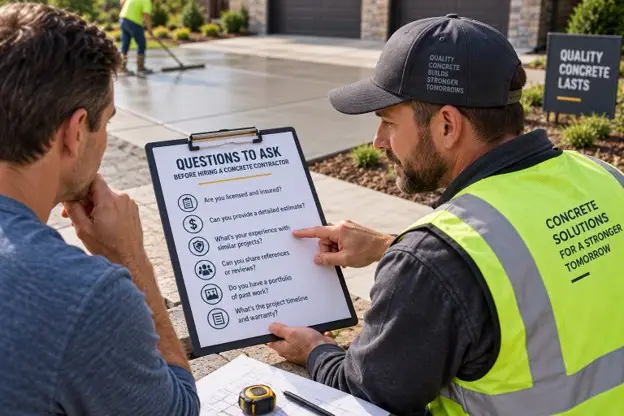
A concrete driveway is one of the few home improvements you’ll live with for decades if it’s done right, or fight with for years if it isn’t. The difference rarely shows up on the day of the pour. It shows up eighteen months later, when the slab has settled unevenly, hairline cracks have opened into real ones, or standing water sits in the same low spot after every rain.
Most of that trouble traces back to decisions made before a single yard of concrete ever touched the ground: how the site was graded, what mix was used, whether joints were placed correctly, and whether the crew doing the work actually carries the insurance they claim to. Homeowners and property managers comparing concrete driveway contractors often focus on price first, but price tells you almost nothing about whether the work will hold up through a WV winter of freeze-thaw cycles. The questions below tell you a lot more.
1. Are You Licensed, Bonded, and Insured?
This is the first question, not a formality. An uninsured crew that damages a utility line, injures someone on your property, or simply disappears mid-project leaves you holding the liability. Ask for proof of general liability insurance and workers’ compensation coverage, and confirm the contractor is licensed to operate in your state.
If you’re getting bids for a larger commercial or multi-state project, ask whether the contractor is licensed to work across state lines. A contractor limited to one city or county can’t scale with you if the project spans a larger service area.
2. What Does Your Site Prep Process Look Like?
A smooth, finished slab hides everything that happened underneath it, which is exactly why so many contractors skip steps here. Ask specifically how they handle excavation, grading, and base compaction before concrete goes down. Poor compaction is the single most common cause of cracking, settling, and drainage problems in residential and commercial concrete work.
A contractor who can describe their prep process in specific terms, not just “we prep the site,” is usually one who takes it seriously. This is also where earthworks and grading experience matters: a crew that regularly handles excavation and base stabilization as its own discipline understands how soil type, moisture, and slope affect what’s built on top of it.
3. What Concrete Mix and PSI Rating Will You Use?
Not all concrete is the same, and the right mix depends on what the slab will handle. A residential driveway, a commercial loading area, and a sidewalk don’t need identical specifications. Ask what PSI (compressive strength) rating they’re using and why, especially if the driveway will see heavier vehicles or regular freeze-thaw exposure.
A contractor who can explain their mix choice in plain terms, rather than giving a vague “standard mix” answer, is one who’s actually thinking about your specific project instead of running the same job every time.
4. How Will You Handle Reinforcement and Control Joints?
Reinforcement (rebar or wire mesh) and properly placed control joints are what keep a slab from cracking randomly as concrete cures and the ground shifts underneath it. Ask where joints will be placed and how far apart, and whether reinforcement is standard for your project or an upgrade.
This is a small detail with an outsized effect on how the driveway looks in five years. Cracks that form outside of a control joint are far more noticeable, and harder to fix cleanly, than cracks that follow a planned joint line.
5. What’s Your Timeline, and How Will Weather Affect It?
Concrete needs the right temperature and moisture conditions to cure properly. In WV and other Appalachian climates, that often means a defined paving season in spring and fall, with contractors booking up fast once the weather turns favorable. Ask how the contractor schedules around weather, what happens if rain or an early frost delays the pour, and how far out they’re currently booking.
A contractor who gives you a vague “we’ll fit you in” answer is less likely to communicate clearly once the project is underway. Look for one who can walk you through a real timeline with specific milestones.
6. Can I See Past Work or Talk to References?
Photos of finished slabs only tell part of the story. Ask to see work that’s a few years old, not just fresh pours, so you can judge how it’s held up to weather and use. If possible, ask for a reference you can call, particularly for a project similar in scale to yours.
A contractor confident in their work will have no problem pointing you to driveways, patios, or commercial pads they poured seasons ago.
7. What’s Included in Your Written Estimate?
A detailed estimate should break down excavation and prep, materials, reinforcement, finishing, and cleanup, not just a single lump-sum number. Vague estimates make it easy for a contractor to cut corners on prep work you can’t see later, or to hit you with change orders mid-project.
Ask specifically what’s excluded, too. Site restoration, disposal of excavated soil, and drainage adjustments are common items that get left out of low bids and added back in later.
8. What Warranty Do You Offer, and What Does It Cover?
Most reputable contractors stand behind their work for a defined period against defects in workmanship, though coverage varies by contractor and project type. Ask what the warranty actually covers (cracking, settling, surface defects) and what would void it, such as heavy equipment driving over a residential slab it wasn’t designed for.
Get the warranty terms in writing before the project starts, not after.
9. Who Is My Point of Contact During the Project?
On larger jobs, especially commercial sites with multiple trades on-site, it matters whether you’re coordinating with a project manager who knows the schedule or getting passed between crew leads with no clear answers. Ask who you’ll be talking to day-to-day and how quickly they typically respond to questions or schedule changes.
This matters even more on projects that involve multiple types of work, like a parking lot that needs concrete, asphalt, and line striping coordinated in sequence.
10. Do You Handle Related Site Work, Not Just the Pour?
A driveway or parking lot project rarely exists in isolation. There’s often grading, drainage, an adjoining asphalt section, or striping and signage that needs to happen before or after the concrete work. Ask whether the contractor handles these pieces directly or whether you’ll need to line up separate subcontractors and manage the handoffs yourself.
A full-service crew that also handles earthworks, asphalt sealing, and snow plowing can spot bigger site issues early and keep a multi-phase project on one schedule instead of several.
Hire With Confidence: Work With CK Services LLC
CK Services LLC is a Fairmont, WV-based site development and pavement maintenance contractor licensed to work across WV, PA, OH, VA, and MD, handling everything from residential driveways to commercial parking lots and industrial pads. Every project starts with proper site prep, grading, base stabilization, and compaction, before concrete or asphalt ever goes down, because a slab is only as good as what’s underneath it.
If you’re comparing concrete driveway contractors and want straight answers to the questions above, reach out through our service area page to talk through your project and get a detailed, written estimate.

Kyle Holcomb
Kyle Holcomb is the owner of CK Services LLC, a paving and site-services company in North Central West Virginia. A Nicholas County native and farm-raised, first-generation college graduate, he earned a BS in Biology and an MS in Integrated Marketing Communication from West Virginia University and worked at Mylan Pharmaceutical before founding CK Services in 2018. Starting with sealcoating, line striping, and crack repair, he grossed roughly $300,000 in his first year and has grown steadily since; expanding into asphalt and concrete, and later large-scale concrete and hauling. He writes about building a hands-on business in the place he calls home.


