

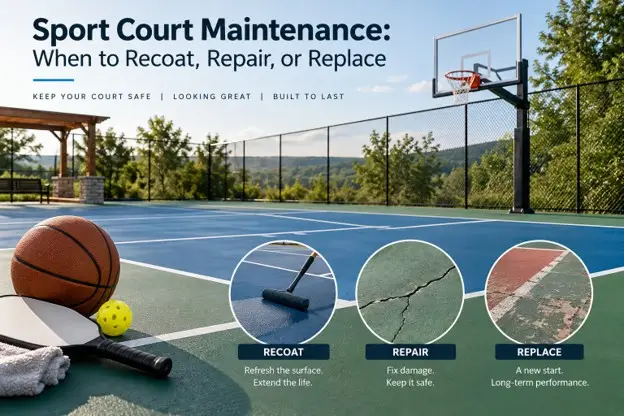
A backyard basketball court or a club’s tennis and pickleball courts don’t fail all at once. They start with a hairline crack near the baseline, a faded patch where water pools after every storm, then a rough spot where the acrylic coating has worn through to the substrate. By the time a player rolls an ankle on a lip in the surface, the court has usually been sending warning signs for a year or more.
Knowing which signs call for a simple cleaning, which call for crack repair, and which mean it’s time to recoat or fully resurface saves real money. Chasing the wrong fix, or waiting too long to do any fix, almost always costs more than catching the problem early.
This guide walks through how sport court surfaces wear, what routine maintenance should look like, and how to tell the difference between a court that needs a recoat, a court that needs targeted repair, and a court that needs to come out and be rebuilt.
How Sport Court Surfaces Wear Over Time
Most outdoor sport courts, whether tennis, pickleball, or multi-use basketball courts, are built on an asphalt or concrete base with an acrylic surface system applied on top. The acrylic coating provides color, texture, and the cushioning that players expect. It’s also the layer that takes the abuse: UV exposure, foot traffic, standing water, and freeze-thaw cycling all wear it down gradually. The base underneath matters just as much as the coating on top. If the asphalt or concrete substrate wasn’t graded and compacted properly before the acrylic went down, the surface will crack and heave no matter how many coats get applied later. A court built on a properly prepped base with real attention to grading, drainage, and compaction will hold its acrylic surface far longer than one where the coating is doing double duty covering up a weak foundation.Routine Maintenance That Extends Court Life
Most of what keeps a sport court in good shape isn’t glamorous. It’s consistent, low-cost upkeep that prevents small problems from becoming expensive ones. Regular Cleaning: Sweep or blow off debris weekly during the playing season, and rinse the surface periodically to remove pollen, dirt, and organic buildup that traps moisture against the coating. Standing debris accelerates wear and can stain the acrylic. Crack Sealing: Hairline cracks in the substrate telegraph through the acrylic surface if they aren’t sealed early. Routine crack sealing, done as soon as a crack appears rather than after it widens, is one of the cheapest ways to extend a court’s usable life. Drainage Checks: Walk the court after a heavy rain and look for standing water. Ponding on a sport court isn’t just an inconvenience, it accelerates coating breakdown and can undermine the base. Persistent ponding usually points to a grading problem that needs correction, not just a surface fix. Line and Color Inspection: Fading lines aren’t just cosmetic. Worn boundary lines create real disputes during play and are often the first visible sign that the top coat is thinning across the whole court.When Recoating Makes Sense
Recoating means applying fresh acrylic surface layers over an existing court that still has a sound base. It’s the most common maintenance event in a sport court’s life cycle, and for courts with regular use, it typically comes up on a multi-year cycle rather than annually. The right interval depends on usage intensity, sun exposure, and how well the court has been maintained in between. Signs that a court is a good candidate for recoating rather than replacement:- The color has faded noticeably but the surface is still smooth and free of major cracking.
- There’s light surface wear or chalking, especially in high-traffic zones like the key or baseline.
- Existing cracks are minor and can be routed and sealed before the new coating goes on.
- The base underneath (asphalt or concrete) shows no significant structural movement.
When Repair Is the Right Call
Repair sits between routine maintenance and a full recoat. It targets specific problem areas rather than the whole surface. Isolated Cracking: A single crack or a cluster of cracks in one section, especially ones that keep reappearing after sealing, may need a more involved patch that addresses the base material underneath before the surface is touched up. Birdbaths: Small depressions that collect water after rain, sometimes called birdbaths, can often be corrected with localized patching and leveling rather than a full resurface, as long as the low spot is limited in size. Edge and Perimeter Damage: Cracking or crumbling at the court’s edges, often from tree roots, vehicle traffic, or poor drainage at the perimeter, is usually a localized fix if caught before it spreads inward. Repair only makes sense when the surrounding surface is otherwise in good condition. Patching a court that’s failing broadly is a short-term band-aid that will need to be redone within a season or two.When Full Resurfacing or Replacement Is Necessary
Some damage goes past what cleaning, crack sealing, or a fresh coat of acrylic can fix. These are the signs that point to full resurfacing or, in more serious cases, tearing out and rebuilding the base entirely:- Widespread Alligator Cracking: A network of interconnected cracks across large sections of the court usually means the base material has broken down structurally, not just the surface coating.
- Repeated Crack Return: If the same cracks keep reopening after being sealed and recoated more than once, the movement is coming from below and surface fixes won’t hold.
- Significant Ponding Across Multiple Areas: When drainage problems show up in more than one spot, it often points to a grading issue built into the original construction that needs to be corrected at the earthworks stage, not patched around.
- Base Failure Visible Through the Coating: Heaving, sunken areas, or exposed aggregate showing through worn acrylic mean the substrate itself needs attention before any new surface goes down.
How WV/Appalachian Weather Affects the Decision
Freeze-thaw cycling is harder on sport courts in West Virginia and the surrounding region than in milder climates. Water that gets into even a small crack, freezes, and expands during a winter thaw cycle can turn a minor surface flaw into a structural problem within a single season. That’s part of why crack sealing before winter and clearing standing water promptly matter more here than in a climate with fewer freeze-thaw swings. Courts that go into winter with unsealed cracks or poor drainage tend to need more aggressive repair or resurfacing work the following spring.Build Your Court’s Maintenance Plan with CK Services LLC
CK Services LLC is a site development and pavement maintenance contractor that handles the full life cycle of a sport court, from base grading and asphalt or concrete substrate work through acrylic surfacing and line striping, for clients across West Virginia, Pennsylvania, Ohio, Virginia, and Maryland. If your court is showing fading, cracking, or drainage problems and you’re not sure whether it needs a recoat, a repair, or a full rebuild, an on-site evaluation is the fastest way to get a straight answer. Reach out through our sport court acrylics page to schedule a look at your court’s current condition.
Kyle Holcomb
Kyle Holcomb is the owner of CK Services LLC, a paving and site-services company in North Central West Virginia. A Nicholas County native and farm-raised, first-generation college graduate, he earned a BS in Biology and an MS in Integrated Marketing Communication from West Virginia University and worked at Mylan Pharmaceutical before founding CK Services in 2018. Starting with sealcoating, line striping, and crack repair, he grossed roughly $300,000 in his first year and has grown steadily since; expanding into asphalt and concrete, and later large-scale concrete and hauling. He writes about building a hands-on business in the place he calls home.


