

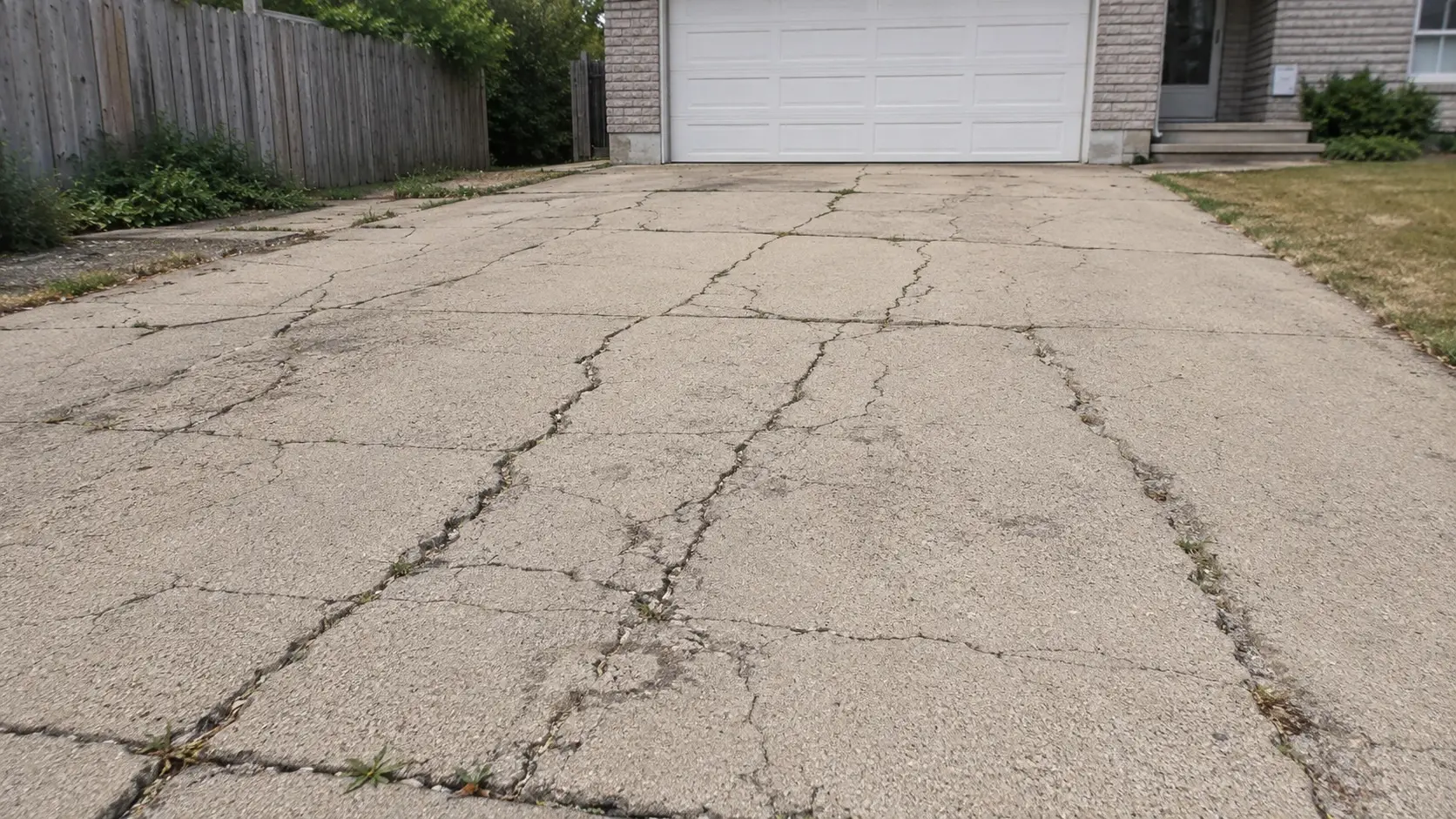
A concrete driveway is one of the hardest-working surfaces on your property. It shoulders the weight of vehicles, endures freeze-thaw cycles, absorbs spilled oil and road salt, and still has to look presentable from the street. When poured and maintained well, concrete can last 25 to 30 years. But no slab lasts forever, and there comes a point when patching and resealing simply throw good money after bad.
Knowing the difference between a driveway that needs minor repair and one that needs full replacement can save you thousands of dollars and a great deal of frustration. Here are seven clear signs that it’s time to stop repairing and start fresh.
1. Deep, Widespread Cracking
Hairline cracks are normal and usually cosmetic. The problem begins when cracks grow wider than a quarter inch, spread across multiple sections, or branch out in a spiderweb pattern. This kind of cracking signals that the structural integrity of the slab is compromised, often because the base beneath it has failed. Once water works its way into deep cracks and freezes, the damage accelerates fast. If your driveway looks more like a road map than a smooth surface, replacement is the smarter long-term move.
2. Potholes and Surface Crumbling
When concrete starts to flake, pit, or crumble, contractors call it spalling. You’ll notice loose gravel, exposed aggregate, and shallow depressions that catch dirt and water. Spalling typically results from a poor original pour, freeze-thaw stress, or years of de-icing salt eating away at the surface. A few isolated spots can be patched, but widespread crumbling means the concrete has lost its density and durability. Potholes are an even clearer red flag, since they indicate the slab is breaking down all the way through.
3. Sinking or Uneven Slabs
A driveway should sit flat and level. If sections have sunk, heaved, or formed noticeable lifts where slabs meet, the soil underneath is shifting or eroding. Uneven concrete isn’t just unsightly; it’s a serious trip hazard and can damage vehicle undercarriages. While mudjacking or slab leveling can correct minor settling, repeated or severe movement usually points to a failing foundation that only a full replacement will fix.
4. Standing Water and Drainage Problems
Properly installed driveways are graded to channel water away from your home and garage. When you start seeing puddles that linger long after the rain stops, the slope has been compromised, often by settling or cracking. Standing water is more than a nuisance. It seeps into existing cracks, undermines the base, and during winter freezes into ice that expands and widens the damage. Chronic pooling that returns after every storm is a strong indicator that the driveway needs to be repoured with proper grading.
5. Stubborn Stains and Discoloration
Oil, rust, leaves, and chemicals leave their mark, and over time concrete can look permanently dingy no matter how often you clean it. On its own, discoloration is mostly cosmetic. But deep, set-in stains often accompany a surface that has become porous and worn, which means the protective top layer has eroded. If your driveway looks tired and weathered despite regular cleaning and sealing, that surface degradation is frequently a sign the concrete is nearing the end of its useful life.
6. Your Driveway Is 20 to 30 Years Old
Age alone is a meaningful factor. Even a well-maintained concrete driveway begins to show its years somewhere between the two- and three-decade mark. Older slabs were often poured with thinner specifications and weaker base preparation than modern standards require. If your driveway is pushing 25 years and showing several of the issues above, replacement gives you a fresh start with better materials, proper reinforcement, and modern installation techniques that will outlast another round of repairs.
7. Repairs Are Adding Up
Perhaps the most practical sign is your maintenance budget. If you find yourself patching cracks every spring, resealing constantly, and fixing the same trouble spots year after year, those costs add up quickly. At a certain point, the cumulative expense of ongoing repairs exceeds the cost of a new driveway that comes with decades of worry-free performance. When repairs no longer hold and the problems keep returning, replacement is almost always the better financial decision.
Don’t Wait Until It Gets Worse
A failing driveway rarely improves on its own. Small problems compound into expensive ones, and a worn surface can drag down your home’s curb appeal and value. The good news is that a professionally installed concrete driveway is a lasting investment that pays you back in durability, safety, and appearance for decades to come.
If your driveway is showing one or more of these warning signs, now is the time to act. The team at CK Services LLC is ready to assess your driveway and deliver a durable, expertly poured replacement built to last. Contact us to get a free estimate today.

Kyle Holcomb
Kyle Holcomb is the owner of CK Services LLC, a paving and site-services company in North Central West Virginia. A Nicholas County native and farm-raised, first-generation college graduate, he earned a BS in Biology and an MS in Integrated Marketing Communication from West Virginia University and worked at Mylan Pharmaceutical before founding CK Services in 2018. Starting with sealcoating, line striping, and crack repair, he grossed roughly $300,000 in his first year and has grown steadily since; expanding into asphalt and concrete, and later large-scale concrete and hauling. He writes about building a hands-on business in the place he calls home.


